Often, when we hear the word “algorithm,” we imagine endless lines of complex code or mathematical formulas from hacker movies. But in reality, the concept of an algorithm is much closer to our daily lives than it seems.
In this article, we will break down what it is, how it works in a regular computer, and why it is critically important for Artificial Intelligence (AI).
In Simple Words: What Is It?
If we remove all technical terminology, an algorithm is simply a sequence of steps that need to be followed to get a result.
The best analogy is a cooking recipe:
- Input data: Eggs, flour, sugar.
- Algorithm (Recipe): Crack eggs, mix with sugar, add flour, put in the oven for 30 minutes.
- Result: Pie.
If you follow the steps in the correct order, you solve the task (cook the food). If you mess up the order, the algorithm won’t work. In the world of computers, an algorithm is exactly such a “recipe,” written in a language the machine understands.
The Three Pillars of Any Algorithm

For an algorithm to work, it always needs three components. Remember the “Input — Process — Output” scheme:
- Input: Data we provide (ingredients for the pie or numbers for calculation).
- Process (Algorithm): The steps and instructions for processing themselves.
- Output: The finished result (baked pie or solved problem).
How Is an Algorithm Related to Artificial Intelligence?
In the context of modern technologies, the definition becomes deeper:
“An algorithm is a set of rules or instructions given to an AI, neural network, or computer program to help it learn on its own and solve problems.”
Here lies an important distinction between a regular program and AI.
Classical Algorithm (Rigid Instruction)
Imagine a traffic light. Its algorithm is simple:
- If 60 seconds have passed, turn on yellow.
- Then turn on red.
This is a rigid rule. The program doesn’t “think”; it simply executes a human’s command.
Algorithm for AI (Learning Instruction)
In the field of Artificial Intelligence, we don’t always give the computer exact instructions on “how to bake a pie.” Instead, we give it a learning algorithm.
We tell the program: “Here are 1000 photos of finished pies and 1000 photos of burnt dough. Find patterns and learn to distinguish good from bad.”
In this case, the algorithm is a set of rules by which the machine learns from its mistakes. It’s like giving a child a construction set and showing a picture of a castle but not giving a step-by-step assembly manual—let them try, make mistakes, and eventually figure out how the pieces fit together best.
Live Example: How It Works in Gemini
To see the difference between rigid rules and an AI algorithm, let’s see how a neural network (e.g., Google’s Gemini) handles a task that would stump a regular program.
Task: Determine if a movie review is positive or negative.
Review: “The movie was a bit dragged out and the beginning was boring, but the acting saved everything, and I ended up absolutely loving it!”
How a classical algorithm would work:
A programmer would write a rule: “If the words ‘boring’ and ‘dragged out’ exist, it’s negative.” The program would see these words and output an error: negative review. It cannot evaluate nuances.
How an AI algorithm (Gemini) works:
The Gemini algorithm was trained on billions of texts. It doesn’t just look for keywords; it “weighs” them in the context of the entire phrase. It understands that “absolutely loving it” at the end outweighs the “boring beginning.”
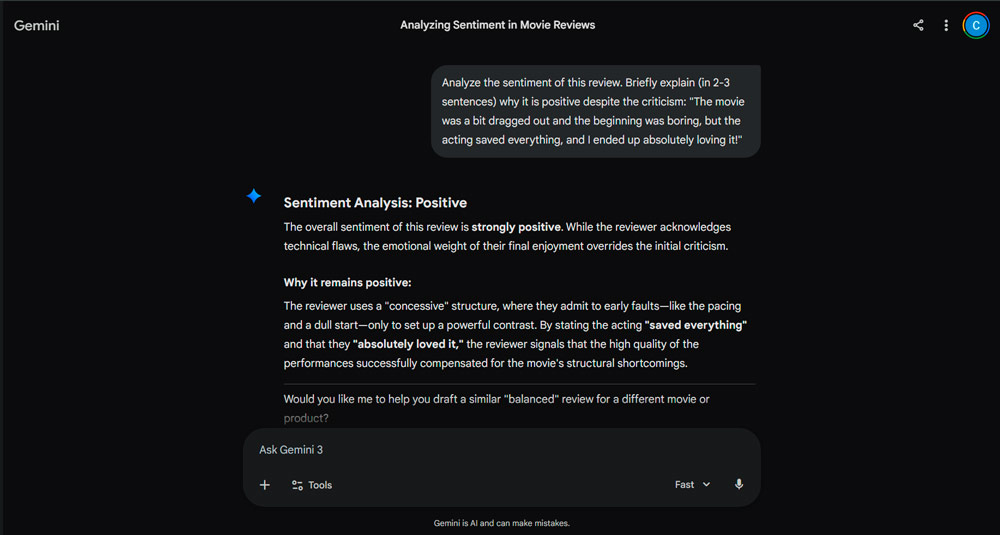
This is the essence: a classical algorithm executes an order, while an AI algorithm makes a decision based on experience.
Why Is This Needed and Where Do We Encounter It?
Algorithms surround us everywhere, and their goal is to save our time or solve tasks that are impossible for humans due to data volume.
- Social Media Feed: An algorithm analyzes what caught your eye and decides: “Aha, the user likes cats, I’ll show them even more cats.” Its goal is to keep your attention.
- Car Navigator: An algorithm scans thousands of route options, considering traffic and road repairs, to give you the single fastest path.
- Email Spam Filters: An algorithm learned from millions of emails and knows: if the subject line says “YOU WON A MILLION,” there is a 99% chance it is garbage that needs to be hidden.
Important Not to Confuse Terms
Beginners often confuse concepts. Let’s distinguish them to avoid confusion:
- Artificial Intelligence (AI): This is the general field of science, the “umbrella” under which everything resides.
- Neural Network: This is a structure mimicking the human brain (tool).
- Algorithm: This is the specific method or instruction by which this neural network operates. Without an algorithm, a neural network is just a useless set of digital connections.
An algorithm is not magic; in the world of AI, it is an instruction that allows a computer not just to execute commands but to find solutions independently, relying on rules we created for it.
FAQ: Frequently Asked Questions
Do I need to be a mathematician to understand how an algorithm works?
No. To use or understand the logic, common sense is enough. To create complex algorithms for AI, math is needed. But the basic principle is pure logic: “If A happened, do B.”
Can an algorithm work incorrectly?
Yes. An algorithm does exactly what it was told. If there is an error in the “recipe” (for example, the programmer provided incorrect data), the result will be bad. This is called “algorithmic bias.” If you teach AI on bad examples, it will produce bad solutions.
Is an algorithm the same thing as code?
Not quite. An algorithm is a plan of action. Code is the language in which this plan is written for the computer. The same algorithm (plan) can be written in different programming languages (Python, Java, C++).
Can an algorithm think like a human?
At this stage of technology development—no. Even the smartest AI algorithm simply predicts the next step based on a huge amount of processed data. It has no consciousness or feelings, only mathematical probability and rules embedded by creators.

 Redactor

