In the rapidly evolving landscape of technology, Artificial Intelligence (AI) serves as the foundational concept. While often conflated with its subfields or specific tools, AI is, at its core, a broad discipline of computer science.
This article explores the definition of AI, how it fundamentally differs from traditional software, and the core capabilities that categorize a system as “intelligent.”
The Core Definition
Artificial Intelligence is the simulation of human intelligence processes by machines, especially computer systems. These processes include learning (the acquisition of information and rules for using the information), reasoning (using rules to reach approximate or definite conclusions), and self-correction.
Unlike standard computing, which focuses on executing explicit commands, AI focuses on goal-oriented behavior. An AI system is designed to perceive its environment and take actions that maximize its chances of achieving a specific goal.
AI vs. Traditional Software
To truly understand AI, it is crucial to distinguish it from conventional automation. This distinction is the dividing line between a “smart” system and a standard program.
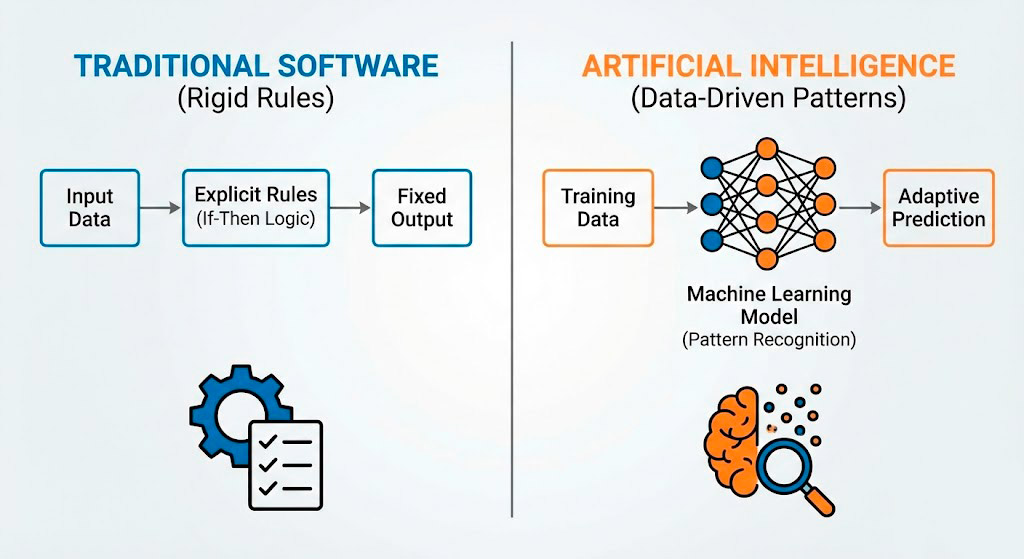
- Traditional Software (Deterministic): Works on an “Input → Process → Output” basis using rigid, pre-written rules. If a scenario occurs that the programmer did not explicitly code for, the system fails.
Example: A standard calculator or a basic tax software. - Artificial Intelligence (Probabilistic): Works by creating models of the world. It can handle ambiguity and variability. Instead of following a strict path, it calculates the probability of the best outcome based on available data.
Example: A spam filter that detects new types of junk email it has never seen before.
The Evolution: Symbolic vs. Data-Driven
The field of AI has evolved through two distinct eras. Understanding this history helps clarify why modern AI behaves the way it does.
Symbolic AI
From the 1950s to the 1980s, AI was largely based on symbolic reasoning (often called “Good Old-Fashioned AI”). Engineers manually encoded knowledge and logic rules into the system. This worked well for logical games like Chess but failed in the messy real world, where rules are hard to define explicitly.
Data-Driven AI
Today’s dominant form of AI relies on inference from data. Instead of being told “cats have triangular ears,” the system analyzes thousands of images to identify the characteristics of a cat on its own. This shift from “knowledge engineering” to “learning from data” is what triggered the current technological revolution.
Primary Capabilities of Intelligent Systems
Regardless of the underlying technology, an AI system generally aims to replicate one or more of these cognitive functions:
- Perception: The ability to scan the environment and extract meaning. This includes Computer Vision (seeing) and Audio Processing (hearing).
- Natural Language Understanding: The capacity to interpret human communication, not just as keywords, but as semantic concepts with context and nuance.
- Reasoning & Problem Solving: The ability to navigate complex constraints to find an optimal solution (e.g., a logistics AI routing delivery trucks).
- Interaction: The ability to communicate results or physically manipulate the world (robotics) based on the processed intelligence.
Conclusion
Artificial Intelligence is not a single technology, but a field of study dedicated to creating machines that can operate autonomously in complex environments. It represents the shift from computers that calculate to computers that cognize.
By understanding AI as the overarching discipline, we can better appreciate the specific tools and methods that sit within this vast ecosystem.

 Redactor

