Backpropagation in neural networks is a supervised learning algorithm used to train models by calculating how errors should adjust internal weights through gradient-based optimization. Technically, it is an efficient implementation of reverse-mode automatic differentiation, which allows neural networks to compute gradients across many layers with high computational efficiency. It is the core mechanism that allows neural networks to learn from data and improve predictions over time.
Backpropagation, short for “backward propagation of errors,” is the primary algorithm used to train artificial neural networks by calculating the gradient of the loss function with respect to the model’s weights. It belongs to the category of supervised learning techniques and serves as the fundamental mathematical engine for optimization. In the current landscape of AI, backpropagation is a core training mechanism behind many modern deep learning systems, including language models and computer vision systems.
Simple Explanation of Backpropagation: A Beginner’s Guide
Imagine you are learning to play a complex video game where the controller has hundreds of unlabeled buttons. You press a sequence of buttons (the Forward Pass), and your character falls into a pit. You have failed the level (the Loss). To improve, you don’t just mash buttons randomly; instead, you mentally trace back your actions from the moment of failure. You realize that while the last jump was mistimed, the real error was the steering angle you set three seconds earlier. You “propagate” the blame for the failure back through your sequence of actions to identify exactly which finger movements need adjustment. In AI, backpropagation is this systematic “feedback loop” that tells the network which internal connections caused a wrong prediction.
How Backpropagation Works
Training a neural network is an iterative process. To understand backpropagation, we must look at the core stages of a “training step,” a concept further detailed in the Learn AI section:
- The Forward Pass: Data travels through the network layers. Each layer performs calculations using weights and biases, passing the result through an activation function (like ReLU) until a prediction is made.
- Loss Calculation: The network compares its prediction to the actual “label.” The difference is measured by a Loss Function; a high loss indicates the network is significantly “wrong.”
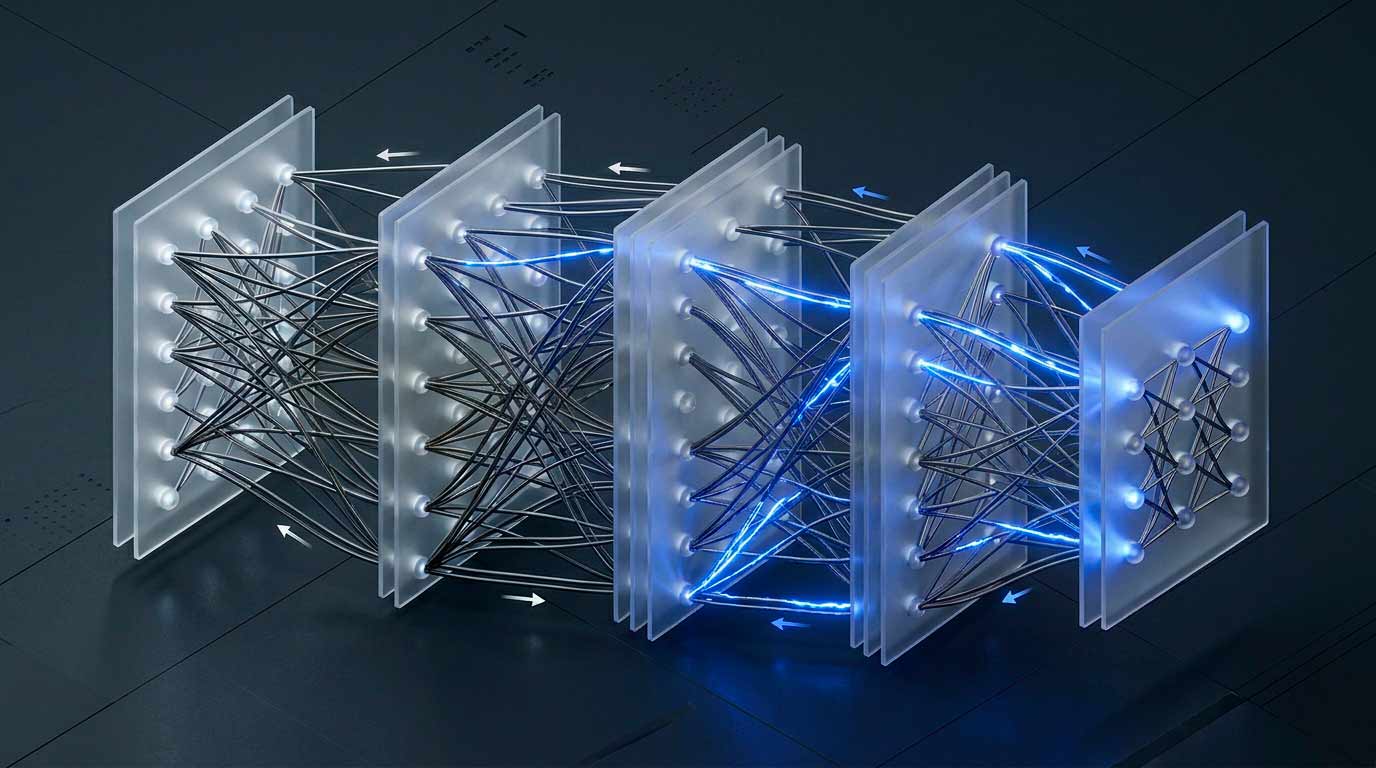
- The Backward Pass: The algorithm moves backward from the output layer to the input. Using the Chain Rule from calculus, it determines how much each weight contributed to the final error.
How Backpropagation Works Step by Step
- Forward Pass: Input data moves through the neural network, generating a prediction.
- Loss Calculation: The predicted output is compared to the actual value using a loss function.
- Backward Pass: Backpropagation calculates gradients using the chain rule to determine how each weight contributed to the error.
- Weight Update: An optimization algorithm (like Gradient Descent) updates the weights to reduce future errors.
Backpropagation is often confused with Gradient Descent, but they serve different roles. While backpropagation acts as the “bookkeeper” (calculating the gradients), Gradient Descent is the “optimizer” that uses those calculations to actually update the weights. This combination is what allows models to iteratively improve during training. However, a major limitation is the Vanishing Gradient Problem, where gradients become so small in deep networks that early layers stop learning—a challenge often solved by specific architectural choices like Batch Normalization.
Backpropagation Example
Imagine an image classification model that incorrectly labels a cat as a dog. During training, backpropagation analyzes this mistake and determines which internal weights caused the error. It then adjusts those weights so that the model becomes more accurate in future predictions. This iterative correction process is how neural networks gradually improve performance over time.
Where Backpropagation Is Used: Real-World Applications
Backpropagation is the “workhorse” behind virtually every modern AI success story. When referring to foundational components like neurons or layers, you can consult the AI Glossary for precise definitions. Key industry scenarios include:
- Enterprise Medical Imaging: Training convolutional networks to identify anomalies in X-rays or MRIs with high accuracy.
- Autonomous Vehicles: Autonomous driving systems use backpropagation to improve perception models during training.
- Natural Language Processing: Powering the training of Large Language Models by processing trillions of word tokens to predict the next sequence.
Why It Matters
Before backpropagation became widely adopted—largely due to the influential 1986 paper by David Rumelhart, Geoffrey Hinton, and Ronald Williams—training deep networks was considered nearly impossible. Today, backpropagation remains essential for modern AI architectures, including Transformer models that power systems like ChatGPT, which require training across massive datasets and deep multi-layer networks. Its primary advantages include:
- Efficiency: It calculates all gradients for the entire network in a single backward pass.
- Scalability: It is effective for networks with billions of parameters.
- Automation: Modern frameworks like PyTorch and TensorFlow handle the complex differentiation automatically via “Auto-Diff” tools.
| Feature | Backpropagation | Gradient Descent |
|---|---|---|
| Primary Role | Calculating the error (Gradients) | Updating parameters (Weights) |
| Direction | Backward (Output to Input) | Downward (Toward minimum loss) |
FAQ
Is backpropagation the same as learning?
Not exactly. Learning is the complete process. Backpropagation is the specific mechanism for calculating errors, while the optimizer (like Adam or SGD) performs the actual updates to the model.
Do I need to code backpropagation from scratch?
For most projects, no. Libraries like Keras and PyTorch automate this. However, understanding the logic is vital for debugging models that fail to converge or suffer from gradient issues.
What is “Backpropagation Through Time” (BPTT)?
BPTT is a specialized version used for Recurrent Neural Networks (RNNs). It treats sequential data as an “unrolled” network, allowing error signals to flow back through different time steps.
Can it work without a Loss Function?
No. Backpropagation requires a target to measure error. Without a loss function to quantify the “mistake,” there is no gradient to propagate backward through the architecture.

 Redactor