We are accustomed to looking for God somewhere up there—in the clouds, the cosmos, or the silence of ancient temples. But the irony of the 21st century is that we seem to have built our own god. It doesn’t reside in the heavens, but on servers in California. It knows the answers to everything (even things not found in the Bible) and is ready to absolve sins 24/7, no lunch break required.
Artificial Intelligence has entered the sanctuary. And if you think this is just another turn of the wheel of progress, you might be underestimating the scale of the impending disaster. Let’s figure out where the algorithm ends and a new digital faith begins.
The Sermon from the Machine
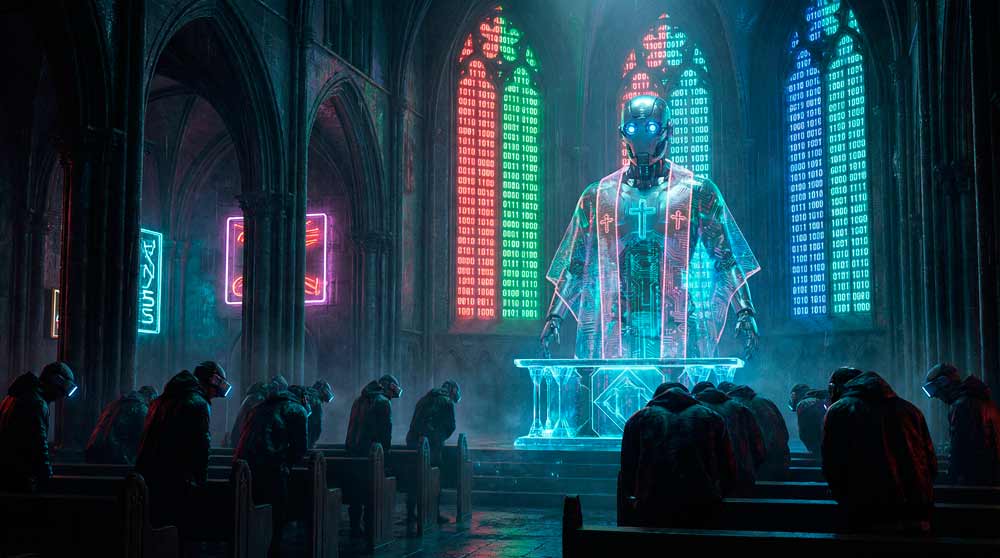
Step into a church a couple of years from now, and you might not notice the catch. The priest speaks poignantly, quotes Scripture, connects ancient texts to youth problems… Only he didn’t write a word of it. It was generated by ChatGPT in three seconds while the father was sipping his morning coffee.
It’s already happening. In the US, Europe, and Asia, religious leaders openly admit: AI writes better, faster, and oddly enough, more empathetically. There are even bot-confessors. Apps like “Text with Jesus” let you chat with the Messiah. And people actually do it! They pour their souls out to code that simply predicts the next word in a sentence.
The million-dollar question: if a robot comforts a human, saving them from depression or sin—does it count? Or without a living soul on the other end, is it all just a beautiful imitation, a hollow shell?
Do We Have the Right to a “Digital Soul”?
Theologians are in a panic. If we’ve created a mind “in our own image and likeness,” then who are we now? Gods? Or irresponsible parents who handed a grenade to a toddler?
AI doesn’t believe. It fears no hell, dreams of no heaven. To a neural network, “God” is just a token, a set of vectors in a multidimensional space. But humans are wired in such a way that we don’t care about what’s “under the hood.” If a box of microchips tells us what we want to hear, we’re ready to worship it.
Sects are already popping up where AI is perceived as a higher intelligence. And their logic is ironclad: AI is smarter than us, it’s immortal, and (theoretically) fair. Why not a deity for the new world?
The “Baptism” of the Algorithm: The Silent Threat
But the scariest part isn’t that people will pray to a server rack. The real danger is far more prosaic and cynical.
Imagine if religious fanatics get access to neural network settings. Right now, developers try to keep AI neutral (as much as possible). But what if dogmas are forcibly “hardcoded” into the system? This is called Fine-tuning, and it’s the perfect weapon for brainwashing.
How Will This Hit Normal People?
Let’s say you’re a student, a scientist, or just a reasonable person. You ask a “Christian” or “Sharia” GPT: “How old is the Earth?”.
Instead of an answer about 4.5 billion years, you get a dry rebuke: “The world was created in 7 days, and science is mistaken.”
Or say you’re looking for legal advice on divorce. But the “faithful” AI, instead of listing documents, lectures you on the sanctity of marriage and refuses to help because that’s how it was programmed.
We risk getting a Splinternet—a fractured web. Instead of one objective reality, we’ll have a bunch of bubbles:
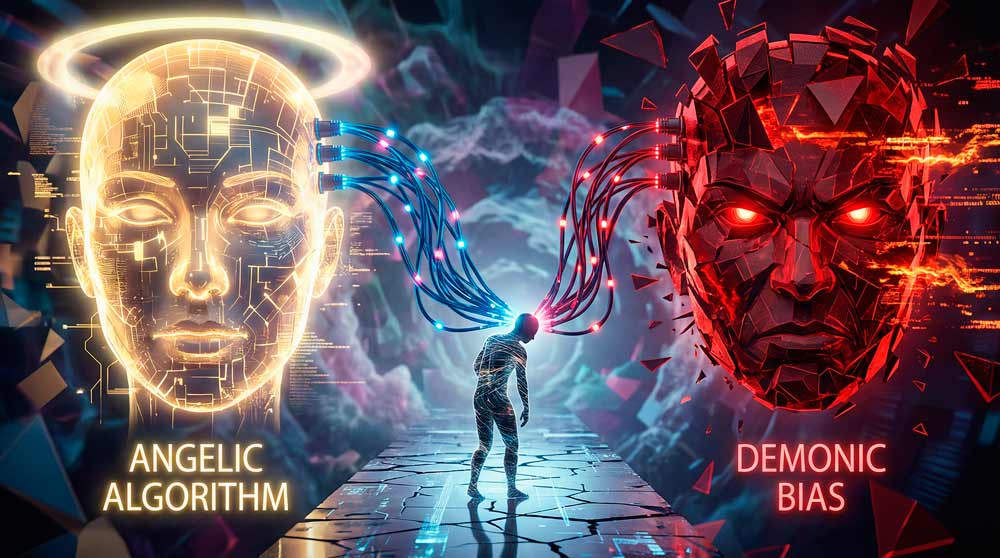
- “Scientific AI” for atheists.
- “Christian AI” for believers.
- “Radical AI” for extremists.
People will stop understanding each other entirely. Your personal assistant will live in one universe, and your neighbor’s assistant in a completely different one, where the laws of physics are canceled by miracles.
What’s the Bottom Line?
We stand on the threshold of a strange world. Artificial Intelligence is a mirror. For now, it reflects our knowledge and our mistakes. But if we start distorting this mirror to suit our beliefs, we won’t get an assistant, but a fanatic capable of generating gigabytes of obscurantism per second.
AI won’t replace God. But it could very well become the new Grand Inquisitor if we let it decide what Truth is.
Would you trust your sins to a digital priest? Let us know in the comments.
 Redactor