Retrieval-Augmented Generation, commonly known as RAG, is a technique used to make artificial intelligence more accurate and reliable. It is a method that allows a Large Language Model (LLM) to look up external information before answering a question, rather than relying solely on what it learned during its initial training.
In the world of AI, RAG is often considered the bridge between a generative model’s creativity and a search engine’s factual accuracy. It helps solve two major problems with standard AI models: the lack of up-to-date knowledge and the tendency to invent false information.
A Simple Guide to Understanding RAG
To understand how this works without technical jargon, imagine a student taking a difficult exam. A standard AI model acts like a student taking a closed-book exam. They must rely entirely on their memory. If they do not remember a fact or if the information has changed since they studied, they might guess or confidently write down the wrong answer.
An AI model using RAG acts like a student taking an open-book exam. When they encounter a question, they do not just guess. Instead, they are allowed to open a textbook, find the relevant chapter, read the exact paragraph, and then write their answer based on that verified information. This process ensures the answer is grounded in reality.
How the RAG Process Works
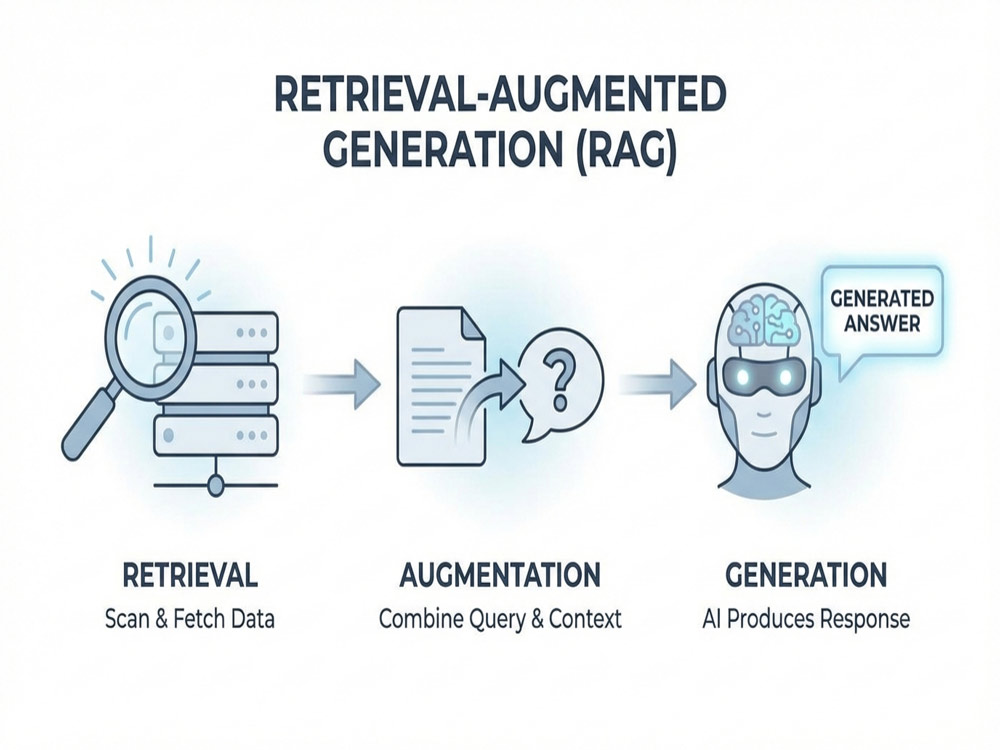
The term Retrieval-Augmented Generation actually describes the three main steps the system takes to answer a user’s prompt:
- Retrieval. When you ask a question, the system first acts like a search engine. It converts your question into a format the computer understands and searches through a trusted database (like your company documents or a specific website) to find relevant data.
- Augmentation. The system takes the specific information it found and attaches it to your original question. It creates a new, enriched prompt that essentially tells the AI: Here is the user’s question, and here are the facts you need to answer it.
- Generation. Finally, the Large Language Model generates the answer. Because it now has the correct facts right in front of it, the model acts as a summarizer and writer, crafting a natural response based on the evidence provided.
Why RAG is Essential for Modern AI
Using this architecture is critical for businesses and developers because standard language models have a cut-off date. For example, if a model was trained in 2023, it will not know about events that happened in 2024. RAG solves this by connecting the AI to live data sources.
Furthermore, this approach significantly reduces hallucinations. Since the model is instructed to verify its answer against the retrieved data, it is much less likely to make things up. This makes the technology safe enough to use for customer support chatbots, legal analysis, and medical research assistants where accuracy is paramount.
Frequently Asked Questions
Is RAG better than fine-tuning an AI model?
For most factual tasks, yes. Fine-tuning teaches a model a new style of speaking or specific jargon, but it is not the best way to teach it new facts. RAG is cheaper and more effective for adding new knowledge because you do not need to retrain the model every time facts change; you simply update the database.
Can RAG prevent all AI mistakes?
While it drastically reduces errors, it does not eliminate them entirely. If the retrieval system finds the wrong document, or if the document itself contains incorrect information, the AI will likely generate a wrong answer. The quality of the output depends heavily on the quality of your data source.
What databases are used for RAG?
Most RAG systems use a specialized technology called a vector database. These databases store text as numbers (vectors), allowing the AI to search for concepts and meanings rather than just matching keywords like a standard search bar.

 Redactor

