OpenAI has introduced a new learning capability in ChatGPT that generates interactive visual explanations for mathematical and scientific concepts. Instead of presenting only text or static diagrams, the chatbot can now display dynamic visual modules that users can manipulate directly while exploring equations and relationships.
The update is designed to help users understand concepts by adjusting variables and observing how results change in real time. The feature currently supports more than 70 topics across mathematics and science and is available globally within ChatGPT.
This development reflects a broader shift toward multimodal educational tools in AI systems. Readers can follow similar developments across the industry in our AI news coverage.
Interactive visual explanations inside ChatGPT
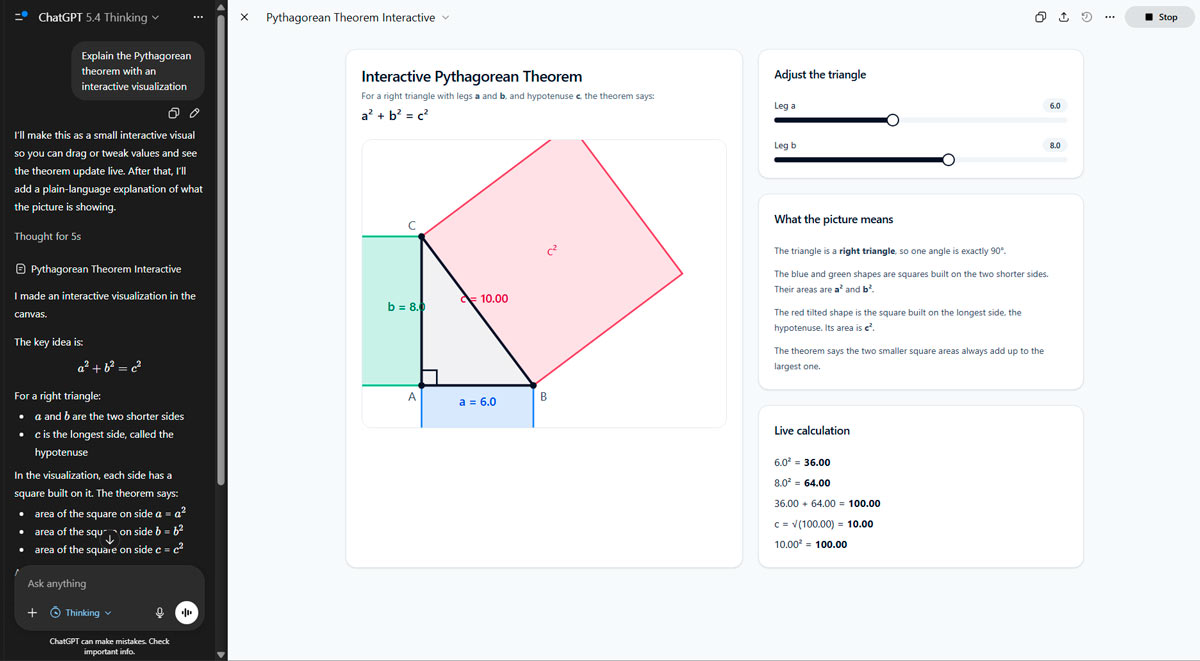
OpenAI says ChatGPT can generate dynamic visualizations when users ask about certain STEM concepts. These interactive modules appear alongside the chatbot’s written explanations and allow users to experiment with formulas and variables.
Instead of viewing a static illustration, users can change numerical inputs and see how graphs, shapes, or calculated values respond.
For example, when exploring the Pythagorean theorem, a user can adjust the sides of a triangle and watch the hypotenuse update in real time. Similar visualizations are available for many other mathematical and scientific relationships.
How to try interactive visual explanations in ChatGPT
OpenAI says the feature currently supports more than 70 STEM concepts and is available across ChatGPT plans globally. |
More than 70 supported math and science topics
The current rollout includes interactive visualizations for over 70 concepts across mathematics and physics. Examples cited in early demonstrations include:
- Pythagorean theorem
- Area of a circle
- Compound interest
- Coulomb’s law
- Exponential decay
- Hooke’s law
- Kinetic energy
- Linear equations
Examples of Interactive STEM Visualizations in ChatGPT
| Concept | Field | What Users Can Explore |
|---|---|---|
| Pythagorean theorem | Mathematics | Adjust triangle sides and see how the hypotenuse changes |
| Area of a circle | Mathematics | Change the radius and observe how the area updates |
| Compound interest | Finance / Mathematics | Modify interest rate or time to see growth over time |
| Coulomb’s law | Physics | Adjust charge values or distance to see how force changes |
| Exponential decay | Mathematics / Physics | Explore how decay rates affect the curve over time |
| Hooke’s law | Physics | Change force or spring constant to observe displacement |
| Kinetic energy | Physics | Adjust mass or velocity to see energy change |
| Linear equations | Mathematics | Modify slope or intercept and observe how the graph shifts |
When a user asks about one of these topics, ChatGPT can generate both an explanation and an interactive module that illustrates how the concept works. Users can adjust variables or parameters and see how those changes affect graphs or calculations in real time.
A shift from static diagrams to interactive learning
Traditional digital learning tools often rely on static images or pre-built simulations. OpenAI’s approach integrates interactive visualizations directly into a conversational interface.
In practice, this means learners can ask questions in natural language and then experiment with a visual representation of the answer without leaving the chat interface.
According to the company, manipulating variables and observing immediate visual feedback may help users better understand the relationships between mathematical and scientific concepts.
Targeting students and self-guided learners
The initial set of topics focuses on core STEM concepts typically taught at the high school and introductory college level. The visual modules allow users to explore formulas, equations, and scientific relationships interactively rather than relying solely on step-by-step explanations.
The tools are available to ChatGPT users across subscription tiers worldwide, according to the company’s announcement.
The feature also expands the role of ChatGPT as a learning interface, combining conversational explanations with interactive visual exploration.
Why it matters
AI assistants have traditionally explained technical subjects using text or static images. By embedding interactive visualizations directly into the conversation, OpenAI is extending ChatGPT into a more hands-on learning environment.
This approach could make complex mathematical and scientific concepts easier to explore, especially for users studying independently or reviewing coursework. It may also attract readers searching for broader ChatGPT updates, including interest around ChatGPT 5.4, even though this announcement specifically focuses on interactive STEM learning tools.
 Redactor