No official release, benchmarks, or technical documentation exist as of March 2026 for DeepSeek’s next AI model, indicating that its specifications remain unconfirmed. Based on scaling trends observed in DeepSeek-V2 and comparable mixture-of-experts frontier systems, projected performance can be estimated using sparse scaling efficiency and MLCommons-class inference envelopes. This report is a technical forecast, and all performance and infrastructure metrics are presented as engineering projections (~Value est.).
- Projected total parameters: ~1.0–1.3 trillion parameters (est.), official benchmarks currently unavailable
- Projected inference throughput: ~350–500 tokens/sec per NVIDIA H100-class node (est.), depending on expert activation ratio
- Projected training compute budget: >5e25 FLOPs total (est.), consistent with trillion-parameter sparse model scaling laws
Executive Summary
- Firm Power: Training and serving a trillion-parameter sparse model is projected to require sustained datacenter rack power densities of ~80–120 kW per rack (est.), driving adoption of direct-to-chip liquid cooling and high-efficiency power delivery systems.
- Operational Density: Sparse mixture-of-experts design enables activation of only ~5–10% of total parameters per token, allowing higher effective model scale without proportional compute increase and enabling higher performance per watt scaling compared to dense architectures.
- Strategic Timeline: Deployment timing will depend heavily on accelerator availability, high-bandwidth interconnect supply, and cluster-scale integration maturity, with projected rollout cycles of 6–12 months following initial model training completion.
Routing Architecture
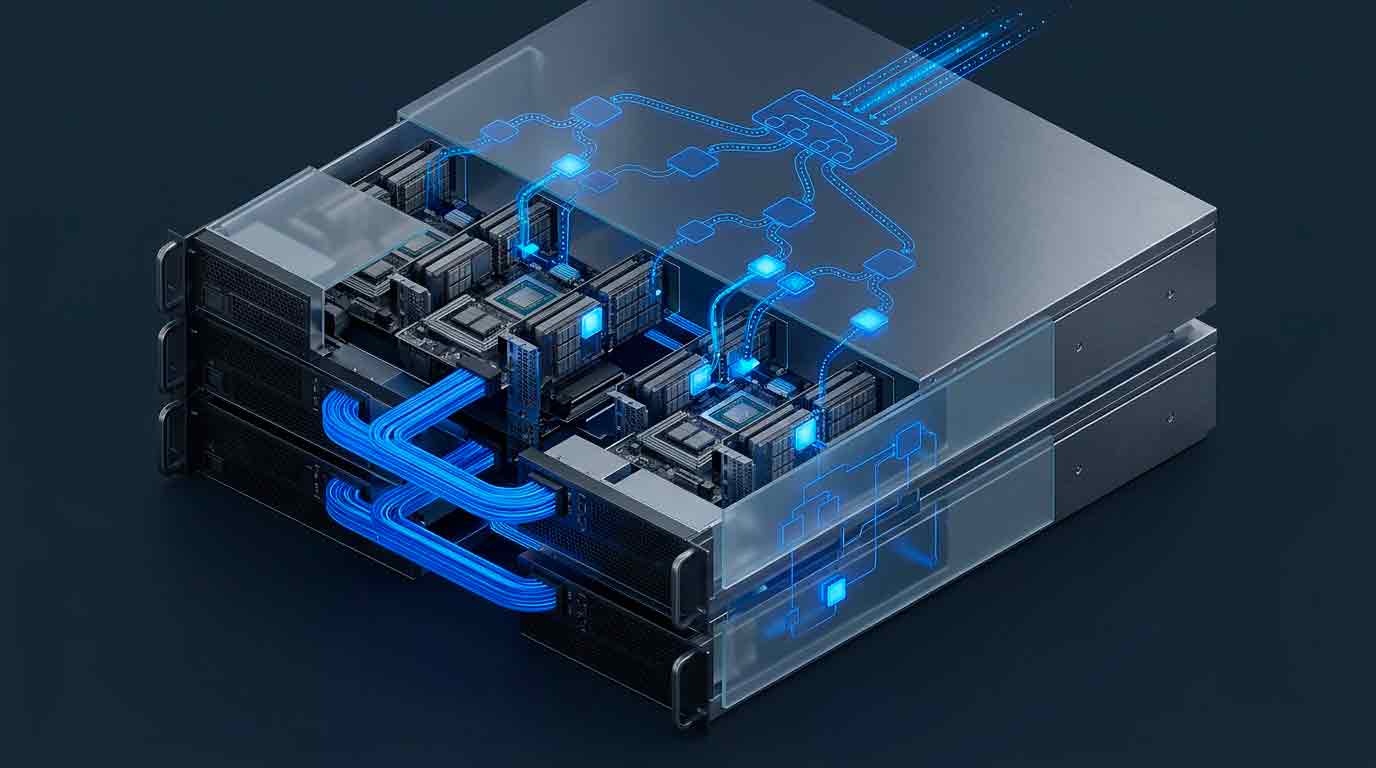
The projected system likely extends hierarchical mixture-of-experts routing, combining sparse feedforward expert layers with shared attention backbones. Tokens are dynamically routed to a small subset of experts, reducing active compute while preserving parameter scale. Performance depends heavily on interconnect bandwidth, expert load balancing, and memory access efficiency across distributed GPU clusters.
Performance Envelope
Sparse trillion-parameter models shift performance constraints from raw compute to memory bandwidth and interconnect efficiency. Compared to dense models, sparse systems deliver higher throughput per unit of compute but require more complex orchestration and scheduling. This architectural shift directly affects datacenter design, inference economics, and accelerator utilization strategies.
| Model | Architecture | Active Parameters per Token | Status |
|---|---|---|---|
| DeepSeek (Projected) | Sparse MoE | ~50–100B (est.) | Forecast |
| DeepSeek-V2 | Sparse MoE | ~20–40B | Released |
| GPT-4-class | Dense / Hybrid (undisclosed) | Undisclosed | Released |
| Gemini 1.5 Pro | Sparse / Hybrid | Undisclosed | Released |
From a CTO perspective, sparse trillion-parameter architectures shift the scaling bottleneck away from compute and toward interconnect bandwidth, memory efficiency, and distributed system stability.
Ainformer Analysis
DeepSeek’s projected next model aligns with the industry transition toward sparse scaling as the dominant method for advancing frontier AI capability. Instead of increasing compute linearly with model size, sparse routing enables exponential parameter growth while maintaining manageable operational costs and inference latency envelopes.
If deployed successfully, such a system would strengthen regional AI infrastructure independence and accelerate adoption of large-scale autonomous systems. The critical limiting factor will not be model design itself, but the availability of high-bandwidth accelerators, efficient cluster networking, and datacenter-scale power and cooling infrastructure required to sustain continuous operation.

 Redactor