For years, we’ve watched Boston Dynamics’ Atlas perform backflips and parkour in choreographed YouTube videos. It was spectacular, but critics always asked the same question: “When will it actually do something useful?” That question was answered this past month. In January 2026, the new all-electric Atlas officially stepped onto the floor of Hyundai’s manufacturing plant in Georgia for real-world field trials. This isn’t just another demo; it’s a pivotal moment where high-end robotics meets the grit of industrial production.
The Shift from Acrobatics to Assembly Lines
The transition from the old hydraulic Atlas to the new electric model is fundamental. While hydraulics provided raw power, they were leaky, complex, and difficult to maintain in a factory environment. The new electric Atlas is sleeker, stronger, and possesses a range of motion that exceeds human capabilities.
To understand why this shift is a game-changer for industrial applications, we have to look at the core technical advantages of the electric architecture:
- Energy Efficiency and Runtime: Unlike bulky hydraulic pumps that require constant pressure, electric actuators draw power only during movement. This significantly extends the robot’s operational window on a single charge.
- Precision Torque Control: Electric servomotors allow for much smoother and more precise force feedback. This is critical for “delicate” tasks, such as handling fragile plastic components or working in close proximity to human coworkers.
- Superhuman Mobility: Without the constraints of rigid hydraulic hoses, engineers implemented joints with infinite rotation. The new Atlas can pivot its torso, head, and limbs 360 degrees, allowing it to manipulate objects in cramped spaces without taking unnecessary steps.
- Industrial Reliability: Hydraulic systems are prone to oil leaks and require complex filtration. The electric architecture makes the robot “cleaner” and more reliable for use in high-tech manufacturing cleanrooms.
- Deep AI Integration: The digital nature of electric drives allows for a direct link between neural network commands and motor movement, minimizing latency when processing real-time sensor data.
At the Hyundai plant, Atlas is tasked with autonomous parts sorting. This requires more than just mechanical strength; it requires “spatial intelligence.” Unlike traditional robotic arms bolted to the floor, Atlas navigates a dynamic environment where humans and machinery are in constant motion.
The Secret Sauce: NVIDIA and Digital Twins
One of the most impressive aspects of these trials is how Atlas “learned” its job. It didn’t spend months failing on the factory floor. Instead, it was trained in NVIDIA’s Isaac Sim, a high-fidelity virtual environment.
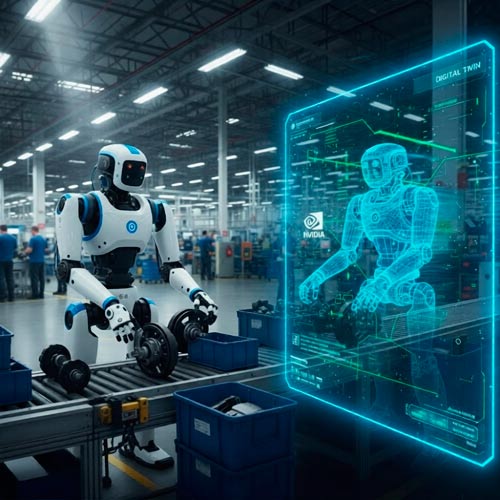
Using Digital Twin technology, Boston Dynamics and Hyundai created a 1:1 virtual replica of the Georgia plant. In this simulation:
- Reinforcement Learning: Atlas performed millions of sorting repetitions in seconds, learning how to handle different weights and textures of car parts.
- Edge Case Testing: Engineers simulated spills, lighting changes, and human obstructions to ensure the robot’s sensors (LiDAR and depth cameras) could adapt without a “safety lobotomy.”
- Sim-to-Real Transfer: By the time the physical robot was powered on in Georgia, it already possessed the “muscle memory” required for the task.
Why This Matters for the Future of Manufacturing
Hyundai’s involvement is strategic. As the owner of Boston Dynamics, they are positioning themselves as the leader in the “Software-Defined Plant.”
The goal here isn’t to replace humans entirely but to automate Dull, Dirty, and Dangerous (the 3 Ds) tasks. Sorting heavy engine components or reaching into ergonomic “dead zones” is where Atlas shines. Because the robot is humanoid, Hyundai doesn’t need to redesign the entire factory layout—Atlas fits into the spaces designed for people.
Separating Humanoid Hype from Industrial Reality
As someone who has tracked the robotics sector for years, I’ve seen many “vaporware” promises. However, the synergy we’re seeing now between Electric Actuators, Generative AI for Path Planning, and NVIDIA’s simulation power creates a “perfect storm.”
We are moving past the “Rule-Based” era (where robots follow a script) and into the “General Purpose Robotics” era. Atlas in Georgia is the first chapter of a story that will eventually see these units in logistics, disaster recovery, and perhaps, eventually, our homes.
Final Thoughts: The Road Ahead
The Georgia trials are scheduled to continue throughout 2026. While Atlas is currently sorting parts, the next phase involves more complex assembly tasks that require fine motor skills and “hand-eye” coordination.
The era of the lab-bound robot is over. The era of the robotic coworker has officially begun.
 Redactor