Baseload power requirements for frontier model training have exceeded the capacity of intermittent renewable grids, necessitating a shift toward high-density fission energy. Meta has finalized a massive procurement strategy to secure 6.6 GW of nuclear capacity by 2035 to sustain its high-performance compute clusters. This multi-vendor agreement with Vistra, TerraPower, and Oklo aims to eliminate the thermal and electrical bottlenecks currently limiting the scaling of Llama-series architectures.
- 6.6 GW total nuclear capacity secured through 2035
- 1.2 GW allocated for the Prometheus AI supercluster in Ohio
- 433 MW of incremental power via reactor uprates at existing facilities
Thermal-Electric Scaling
Modern AI clusters like Meta’s Prometheus require massive, uninterrupted power densities to support H200 and Blackwell GPU nodes during the critical training phases of Llama 4 and 5. By integrating advanced Natrium sodium-cooled fast reactors and Aurora Powerhouse modules, Meta achieves a steady-state energy profile that supports 390 TFLOPs per GPU. This architecture mitigates the latency jitter often introduced by traditional grid curtailment or load-shedding events during peak demand cycles.
Infrastructure Synergy
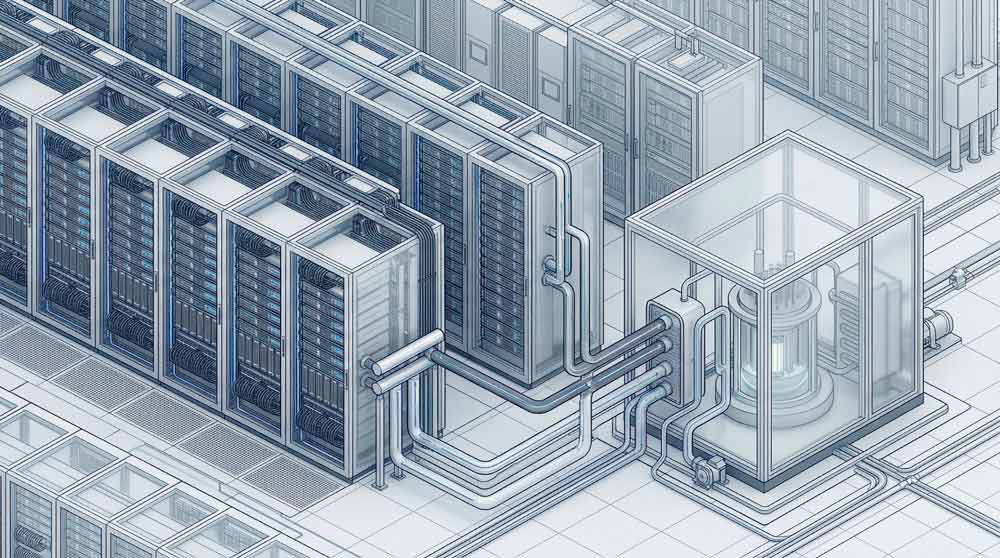
The transition to on-site or direct-purchase nuclear power allows Meta to bypass regional transmission delays that have historically pushed data center lead times beyond 48 months. By financing 20-year Power Purchase Agreements (PPAs), Meta is effectively capitalizing the next generation of Small Modular Reactors (SMRs). This strategy ensures that while competitors face grid-connection queues, Meta’s Ohio and Pennsylvania facilities will maintain a distinct advantage in FLOPs-per-watt efficiency and long-term cost predictability.
| Feature | Meta (Nuclear-Led) | AWS (Modular Focus) | Google (SMR Focus) |
|---|---|---|---|
| Total Capacity (Target) | 6.6 GW | ~5.0 GW (est.) | ~1.1 GW (est.) |
| Primary Tech Partner | Vistra / TerraPower | X-Energy / Dominion | Kairos Power |
| Earliest Deployment | 2026 (Grid) / 2030 (SMR) | 2027 (Grid) / 2031 (SMR) | 2030 (SMR) |
“As AI models move from 10^25 to 10^27 FLOPs, we are shifting from a ‘compute-constrained’ to an ‘electron-constrained’ era. This nuclear pivot isn’t just about sustainability; it’s about the physical survival of super-intelligent scaling laws.”
Ainformer Analysis
Meta’s decision to anchor its future on 6.6 GW of fission represents a fundamental decoupling from the merchant power market. By financing SMR developers like Oklo and TerraPower, Meta is essentially verticalizing its energy supply chain to match the vertical integration of its PyTorch/Llama software stack. We anticipate this move will force a secondary market for specialized “AI-ready” reactors that prioritize thermal management and rapid load-following capabilities to handle the bursty nature of inference workloads.
Furthermore, the 2026 launch of the Prometheus cluster marks a critical test for large-scale GPU orchestration powered by “firm” energy. If Meta successfully maintains 99.999% uptime during massive Llama 5 training runs without grid reliance, it will set a benchmark for sovereign AI infrastructure that others must follow to remain competitive in the reasoning-tier performance bracket.
 Redactor