Tesla has transitioned its Optimus humanoid robots from laboratory testing to initial operational roles within the Gigafactory Texas production ecosystem. As of early 2026, the company has deployed a specialized fleet of Optimus units to assist with logistics and battery component handling. This marks a significant phase in Tesla’s “dogfooding” strategy, where the robots are integrated into real manufacturing workflows to identify edge cases in a high-volume environment. Currently, these bipedal systems are working in designated zones alongside human teams, performing repetitive tasks such as the autonomous sorting of 4680 battery cells and moving lightweight components between assembly stations.
Operational Integration and Autonomous Logistics
The deployment at Giga Texas focuses on validating two primary capabilities: precision tactile handling and dynamic navigation. The robots feature advanced hands with tactile sensors that allow them to handle delicate battery parts without damage. In this current pilot phase, the robots are focused on the following objectives:
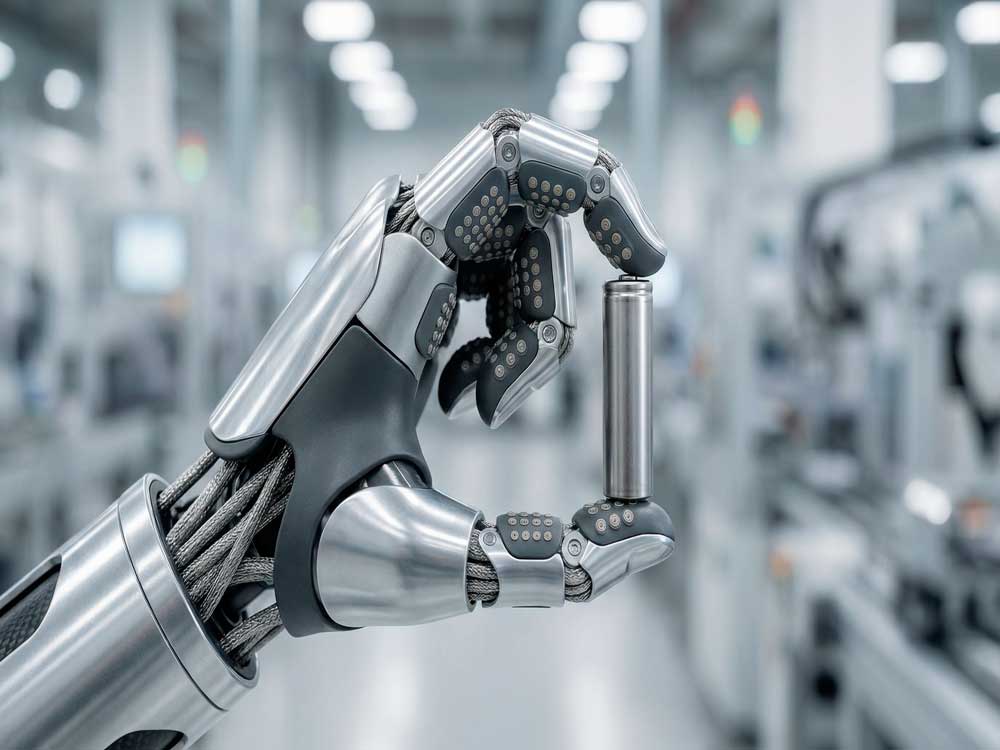
- Automated sorting and visual inspection of battery cells to support quality control lines.
- Point-to-point logistics, where robots navigate mapped factory corridors to deliver small parts to vehicle assembly stations.
- Data collection for neural network training, using real-world factory obstacles to improve obstacle avoidance.
To ensure continuous operation, Tesla utilizes dedicated docking stations. When the 2.3 kWh battery pack reaches a low-power threshold, the robot independently navigates to a charging bay. While Tesla is exploring various charging methods, current units primarily use a precise contact-based docking sequence to rapidly replenish power and return to their assigned tasks, minimizing the need for human intervention.
Advanced Hardware and the AI5 Neural Engine
The intelligence driving the Optimus fleet is powered by Tesla’s latest AI inference hardware, designed to process high-resolution visual data locally. This “AI5” architecture enables the robot to perceive its surroundings through an integrated camera suite, utilizing the same occupancy network technology found in Tesla’s Full Self-Driving (FSD) software. The hardware features a lightweight design, weighing approximately 56 kilograms, achieved through a strategic mix of high-strength materials and aluminum alloys. Enhanced balance control and integrated foot force-torque sensors allow these units to maintain stability on standard factory flooring while carrying payloads of up to 10–15 kilograms, meeting the safety requirements for collaborative work environments.
Economic Scaling and Production Targets
Tesla’s strategy for humanoid robotics involves leveraging the massive supply chain and manufacturing expertise gained from the Model Y and Cybertruck programs. While mass commercial availability is still on the horizon, Giga Texas is being optimized to serve as the primary manufacturing hub for future Optimus generations. Tesla aims to simplify the robot’s design to reduce the “bill of materials” (BOM), targeting a long-term unit cost of approximately $20,000 to $30,000. By focusing on general-purpose flexibility rather than fixed industrial automation, Tesla intends to create a versatile workforce that can be redeployed across different factory sections with simple software updates, significantly lowering the cost of automated labor.
Expert Forecast by Ainformer
The presence of Optimus on the floor of Giga Texas represents the first major step toward the “lights-out” manufacturing vision. We anticipate that 2026 will be a “year of refinement,” where Tesla focuses on increasing the reliability and mean time between failures (MTBF) for its robotic fleet. While initial deployment numbers are in the hundreds, the data gathered in Austin will be critical for the planned production ramp in late 2026 and 2027. The primary challenge remains the transition from teleoperated “learning” to full task autonomy in unscripted scenarios. As Tesla scales its proprietary actuator production, we expect Optimus to become a benchmark for the humanoid industry, forcing a rapid shift in how global logistics and automotive assembly are structured.

 Redactor